mirror of
https://github.com/bendtherules/blog-hashnode-backup.git
synced 2026-08-18 13:42:04 +00:00

81 lines
4.8 KiB
Markdown
81 lines
4.8 KiB
Markdown
## What is `this` inside foo.bar()?
|
||
|
||
## The problem
|
||
|
||

|
||
|
||
When we pass a method as callback, it loses reference to the original object (as `this`) when it is called.
|
||
But calling a method directly works as expected.
|
||
|
||
Why is that? **Can the spec help us explain this difference?**
|
||
|
||
*(For simplicity, let's assume the caller doesn't intend to pass a different `this` value here, and calls onClick() directly)*
|
||
|
||
------
|
||
|
||
## The explanation
|
||
|
||
##### For methods,
|
||
⭐️ `foo.bar()` translates to `foo.bar.call(foo)`.
|
||
|
||
That is, when a method (function which is accessed as a object property) is called, the object gets passed as `this` inside the function.
|
||
|
||
So, in this case -
|
||
*What* → foo is passed as `this` inside bar
|
||
*When* → if bar is a function and *accessed as object property* (i.e. foo.bar).
|
||
|
||
##### For functions,
|
||
⭐️ `fn()` translates to `fn.call(this)`
|
||
(where `this` is taken from caller's scope)
|
||
|
||
##### Method to function,
|
||
Now, if we were to rewrite `foo.bar()` using a intermediate variable - ` bar1 = foo.bar; bar1()`,
|
||
then the value of `this` inside bar will change from `foo` to the `outer this`.
|
||
|
||
If `bar` was referencing other values from foo using `this`, those values will become undefined or resolve to a wrong variable.
|
||
|
||
🧠 This is exactly the reason why passing methods as callback changes the value of `this` (passed within it). Instead of calling a method directly, callback is passed as a function and called later by some other code.
|
||
|
||
##### In other words,
|
||
|
||
⭐️ When `foo.bar` is called, the function `bar` is not aware that it is "attached" to the object foo. Based on the exact syntax of a function call, if the language can figure out a clear `someThing.someFunction()` structure, then it will happily forward someThing as this.
|
||
|
||
But, if you take out a function from a object and call it separately, there is no way to figure out which object it was originally attached to. Hence, `this` will be set from caller's scope.
|
||
|
||
-------
|
||
|
||
## 📖 What does the spec say?
|
||
|
||
|
||
|
||
|
||
|
||
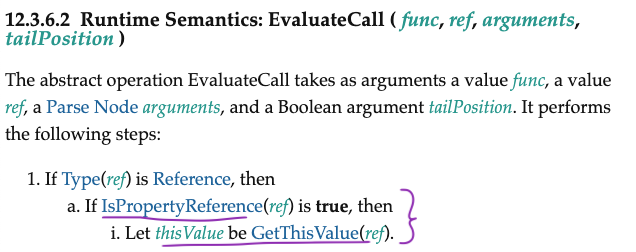
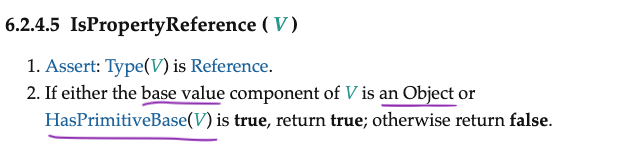
Link - 1. https://tc39.es/ecma262/#sec-evaluatecall, 2. https://tc39.es/ecma262/#sec-ispropertyreference
|
||
|
||
This `foo.bar` structure is defined in the spec as a [PropertyReference](https://tc39.es/ecma262/#sec-ispropertyreference).
|
||
Think of PropertyReference as anything that is valid as the left side of an assignment expression, if you were assigning to the property of a object or primitive.
|
||
|
||
**PropertyReference = Reference + base is object or primitive**
|
||
|
||
Some examples of valid and invalid PropertyReference -
|
||
|
||
%[https://gist.github.com/bendtherules/3467664a9c567617342b73c3681c1dc7]
|
||
|
||
|
||
⭐️ If it is a PropertyReference, then set `thisValue` to base of the PropertyReference (i.e. `foo` in `foo.bar`).
|
||
⭐️ Or else, take thisValue from surrounding Environment Record.
|
||
|
||
The obtained `thisValue` is forwarded to the abstract operation [Call](https://tc39.es/ecma262/#sec-call), which in turn verifies that the resolved value of `foo.bar` is a function and then calls the internal method [function.[[Call]]](https://tc39.es/ecma262/#sec-built-in-function-objects-call-thisargument-argumentslist) with the same thisValue.
|
||
This [[call]] interface is very similar to the `function.call` public interface and can be approximated with that.
|
||
|
||
#### A few interesting things to note -
|
||
1. `foo.bar` is resolved as a string or symbol "bar" within the object `foo` - and goes through the [usual resolution process](https://tc39.es/ecma262/#sec-getvalue) honoring getters, proxies and prototype chains.
|
||
2. The function `foo.bar` doesn't need to be a [simple function object](https://tc39.es/ecma262/#sec-ecmascript-function-objects), but it can be anything with a [[call]] interface like a exoctic [bound function](https://tc39.es/ecma262/#sec-bound-function-exotic-objects-call-thisargument-argumentslist) or a proxy.
|
||
Bound functions, for example, ignore the `thisValue` that was passed in and instead uses internal [[BoundThis]] as the actual this (which is stored from when it was created). That is why one solution to this callback problem is to bind a function before passing it as a callback.
|
||
|
||
----
|
||
|
||
*That's all! Hope you had a interesting read.
|
||
I would really appreciate if you leave some feedback.*
|
||
|
||
*If you want to start reading ecmascript specification yourself, https://timothygu.me/es-howto/ is a great starting point.* |