
4.8 KiB
What is this inside foo.bar()?
The problem

When we pass a method as callback, it loses reference to the original object (as this) when it is called.
But calling a method directly works as expected.
Why is that? Can the spec help us explain this difference?
(For simplicity, let's assume the caller doesn't intend to pass a different this value here, and calls onClick() directly)
The explanation
For methods,
⭐️ foo.bar() translates to foo.bar.call(foo).
That is, when a method (function which is accessed as a object property) is called, the object gets passed as this inside the function.
So, in this case -
What → foo is passed as this inside bar
When → if bar is a function and accessed as object property (i.e. foo.bar).
For functions,
⭐️ fn() translates to fn.call(this)
(where this is taken from caller's scope)
Method to function,
Now, if we were to rewrite foo.bar() using a intermediate variable - bar1 = foo.bar; bar1(),
then the value of this inside bar will change from foo to the outer this.
If bar was referencing other values from foo using this, those values will become undefined or resolve to a wrong variable.
🧠 This is exactly the reason why passing methods as callback changes the value of this (passed within it). Instead of calling a method directly, callback is passed as a function and called later by some other code.
In other words,
⭐️ When foo.bar is called, the function bar is not aware that it is "attached" to the object foo. Based on the exact syntax of a function call, if the language can figure out a clear someThing.someFunction() structure, then it will happily forward someThing as this.
But, if you take out a function from a object and call it separately, there is no way to figure out which object it was originally attached to. Hence, this will be set from caller's scope.
📖 What does the spec say?
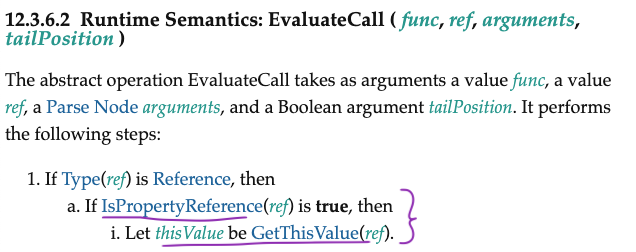
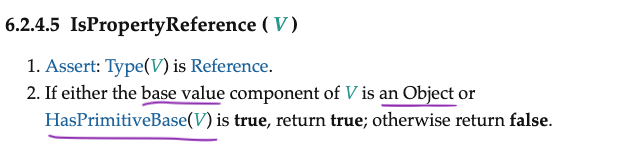
Link - 1. https://tc39.es/ecma262/#sec-evaluatecall, 2. https://tc39.es/ecma262/#sec-ispropertyreference
This foo.bar structure is defined in the spec as a PropertyReference.
Think of PropertyReference as anything that is valid as the left side of an assignment expression, if you were assigning to the property of a object or primitive.
PropertyReference = Reference + base is object or primitive
Some examples of valid and invalid PropertyReference -
%[https://gist.github.com/bendtherules/3467664a9c567617342b73c3681c1dc7]
⭐️ If it is a PropertyReference, then set thisValue to base of the PropertyReference (i.e. foo in foo.bar).
⭐️ Or else, take thisValue from surrounding Environment Record.
The obtained thisValue is forwarded to the abstract operation Call, which in turn verifies that the resolved value of foo.bar is a function and then calls the internal method function.[[Call]] with the same thisValue.
This call interface is very similar to the function.call public interface and can be approximated with that.
A few interesting things to note -
foo.baris resolved as a string or symbol "bar" within the objectfoo- and goes through the usual resolution process honoring getters, proxies and prototype chains.- The function
foo.bardoesn't need to be a simple function object, but it can be anything with a call interface like a exoctic bound function or a proxy.
Bound functions, for example, ignore thethisValuethat was passed in and instead uses internal BoundThis as the actual this (which is stored from when it was created). That is why one solution to this callback problem is to bind a function before passing it as a callback.
That's all! Hope you had a interesting read.
I would really appreciate if you leave some feedback.
If you want to start reading ecmascript specification yourself, https://timothygu.me/es-howto/ is a great starting point.